Select Program
Child Protection
Education
Emergency Response
Youth Development
Water, Sanitation & Hygiene
Health & Nutrition
Food Security
Environmental Sustainability
Child Sponsorship
Early Childhood Development
Localization
Select Type
Capacity Statement
Journal Article
Manual, Toolkit or Guide
Policy Brief
Project Brief
Report
Research
Select Year
2025
2024
2023
2022
2021
2020
2019
Select Region
Addis Ababa City
Countrywide

2022

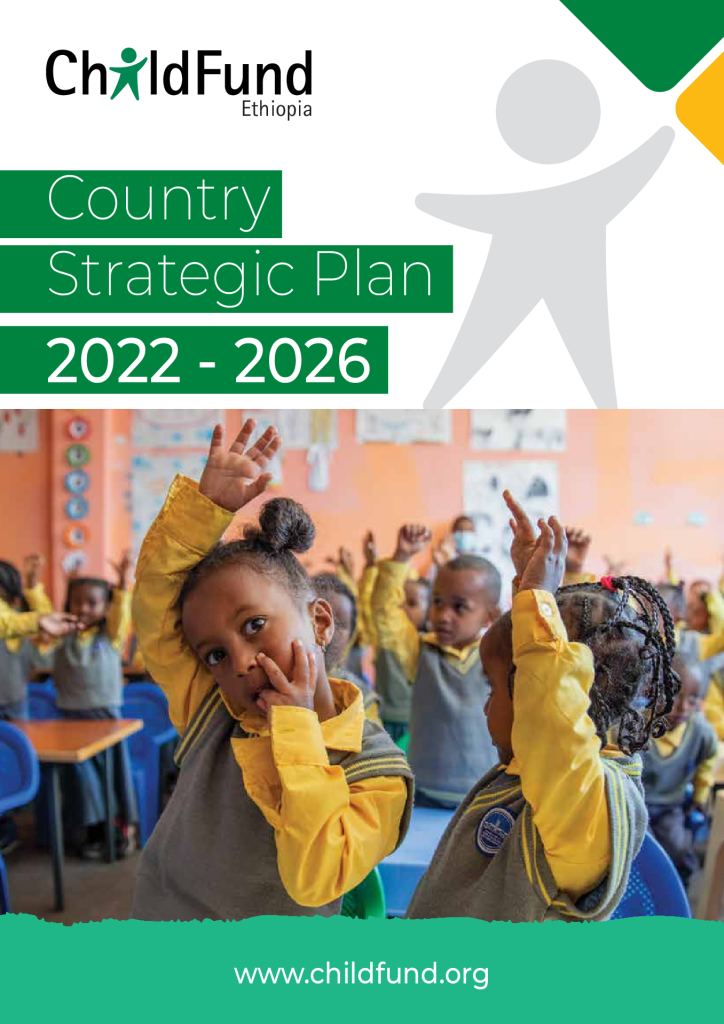
ChildFund Ethiopia’s current Country Strategic Plan 2022 – 2026 has an ambitious goal to reach approximately 7 million children, their families, and communities annually by the end of 2026. During this period, we will strive to explore more innovative and creative ways to scale up our reach and impact, through embracing technology, adopt digitalization, improving our systems for efficiency, building on our program models, expanding our humanitarian footprint, and diversifying our funding base and scaling up our fundraising. We are cognizant that we cannot do this on our own and expanding our partnerships will be critical to achieving this goal.

2024

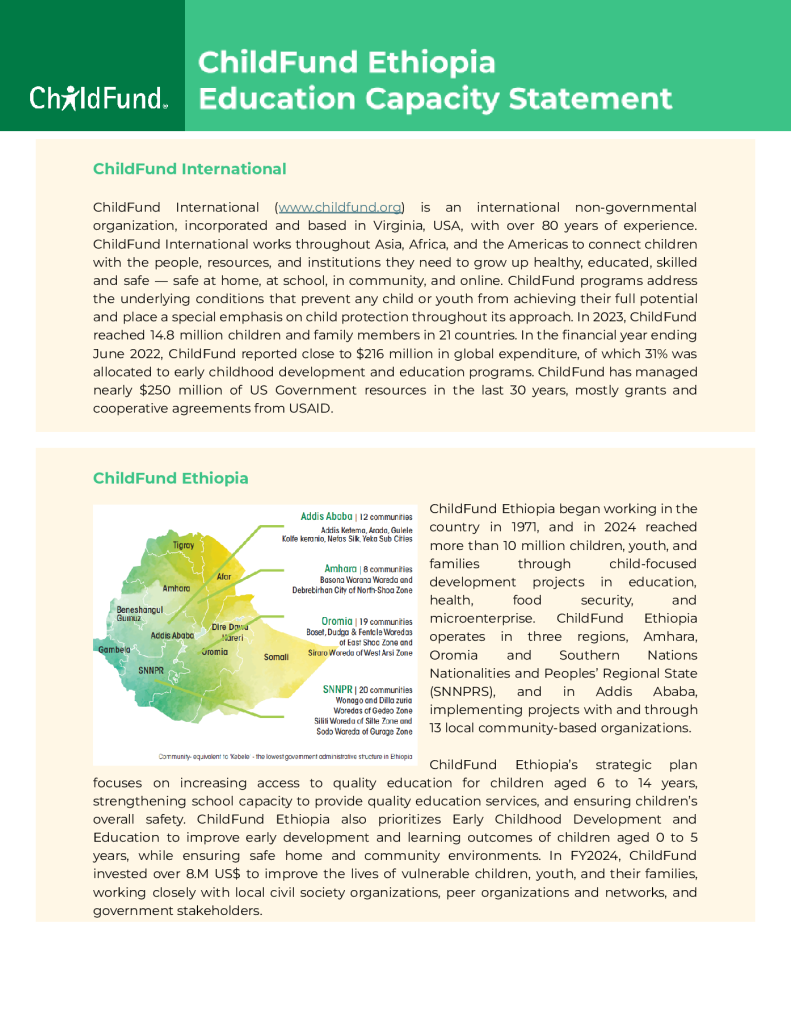
ChildFund Ethiopia’s strategic plan focuses on increasing access to quality education for children aged 6 to 14 years, strengthening school capacity to provide quality education services, and ensuring children’s overall safety. ChildFund Ethiopia also prioritizes Early Childhood Development and Education to improve early development and learning outcomes of children aged 0 to 5 years, while ensuring safe home and community environments. In FY2024, ChildFund invested over 8.M US$ to improve the lives of vulnerable children, youth, and their families, working closely with local civil society organizations, peer organizations and networks, and government stakeholders.

2021

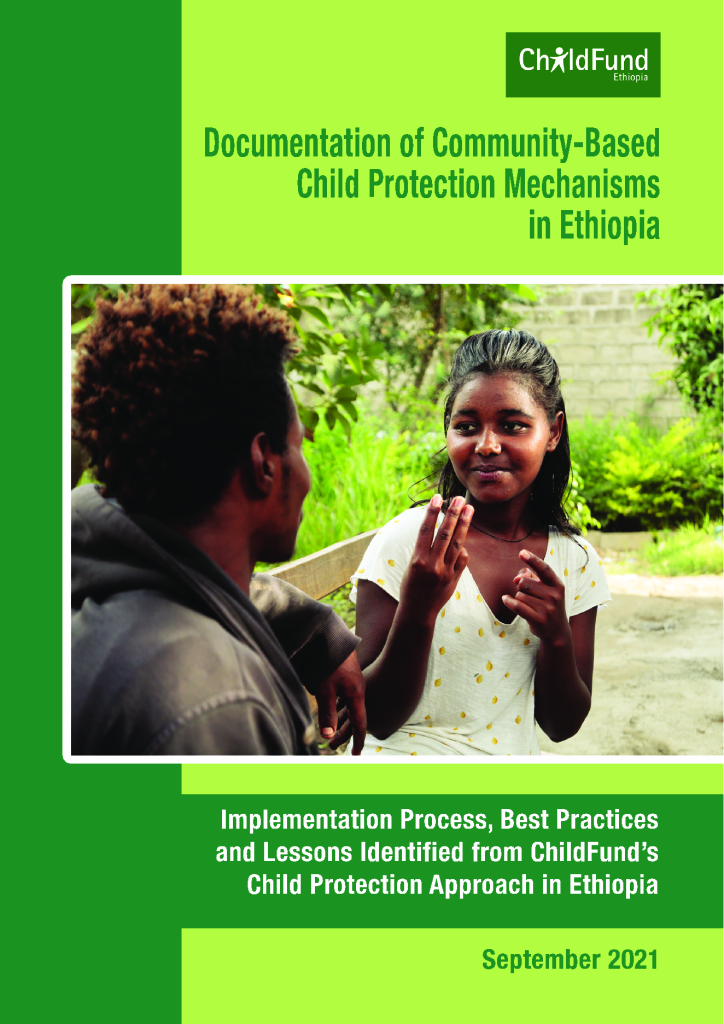
ChildFund integrates child protection as a core, cross-cutting theme across all its programs, with the Community-Based Child Protection Mechanism (CBCPM) serving as a key strategy. Implemented in Addis Ababa and various rural and urban areas of the Central Ethiopia, South Ethiopia, Amhara, and Oromia regions, the CBCPM approach aims to strengthen existing child protection systems to effectively prevent and respond to cases of violence, abuse, neglect, and exploitation. The initiative brings together a wide network of actors, including 13 local NGOs/CSOs, government ministries, academic institutions, caregivers, children, and community leaders, to create a robust and inclusive protection environment for children. This documentation effort seeks to capture the implementation process, best practices, and lessons learned from CBCPM to inform future programming and encourage replication.

2023

Despite notable global progress in reducing preventable maternal and newborn deaths, many countries still experience unacceptably high rates of maternal and newborn morbidity and mortality. The primary contributor to this ongoing crisis is the poor quality of care during pregnancy, childbirth, and the postnatal period. To address these gaps, there is an urgent need for transformative and patient-centered approaches that prioritize respectful, high-quality care for every mother and newborn. One such promising and evidence-based solution is the Networks of Care (NoC) model. NoC is an innovative approach aimed at optimizing the functionality of health systems by deliberately fostering and strengthening the relationships between different components and actors within the system.

2023

ChildFund recognizes that environmental changes are not only ecological challenges but also a serious child rights crisis, directly threatening children’s survival, development and future. In response, we implement child-centered, locally-led programs aligned with Ethiopia’s national strategies complementing; the Climate Resilient Green Economy (CRGE) strategy and the National Adaptation Plan (NAP), by scaling up community action to reach the nation’s goal of carbon neutrality by 2030. Our initiatives also support the Long-Term Low Emission and Climate Resilient Development Strategy (LT-LEDS) 2050, and the Green Legacy Initiative (GLI), a national reforestation campaign. This capacity statement presents a snapshot of our work to build environmental sustainability among vulnerable populations, particularly children and their families.

2023

ChildFund International is on an exciting journey. With our newest organizational strategy, Growing Connections 2030, we look toward a future where we will not only create impact with more children and families than ever before, but we will do so through expanded partnerships and deeper relationships. As the world changes, the people and institutions focused on child well-being must rise to its new challenges and help more children connect with what they need to thrive. It is more urgent than ever that we rise to those challenges together — so that children can rise to theirs. We hope our vision for the future of our work inspires you to join us on this path. Because, to reach our ambitious goals, we need each other.

2020

When young people are not active participants in the decision-making processes that affect their lives, they—and their communities—often suffer worse outcomes. Too often, decisions that will affect young people’s lives are made solely by parents, local and religious leaders, teachers, governments and others without the input of youth themselves. Young people who are in marginalized communities, living with disabilities, or facing unfair gender disparities face even tougher development barriers to having their voices heard. By focusing on youth agency and positive youth development, ChildFund supports the principle that young people are empowered to reach their full potential through skill-building, fostering healthy relationships, strengthening families and communities, and transforming systems.

2020

Young people make up a huge proportion of the world’s population. Roughly 1.8 billion people are between the ages of 10 and 241, and the challenges they face today are stark: In 2020, more than 1 in five young people worldwide aged 15-24 was not employed, in job training or in school, and this has only worsened since the COVID-19 pandemic. ChildFund’s livelihood programming focuses broadly on youth work and entrepreneurial skills, employability and work readiness. Many of our programs also overlap with youth participation programming and adolescent sexual and reproductive health so we are able to holistically support youth through this life stage, properly preparing them not only for work, but for being able to stay employed, continue their education and remain safe and healthy.