Select Program
Child Protection
Education
Emergency Response
Youth Development
Water, Sanitation & Hygiene
Health & Nutrition
Food Security
Environmental Sustainability
Child Sponsorship
Early Childhood Development
Localization
Select Type
Capacity Statement
Journal Article
Manual, Toolkit or Guide
Policy Brief
Project Brief
Report
Research
Select Year
2025
2024
2023
2022
2021
2020
2019
Select Region
Addis Ababa City
Countrywide

2020

At ChildFund, we characterize our impact in Africa, Asia, and the Americas using four key dimensions: (1) the positive change we see in our core outcomes as measured by performance data — our global monitoring of key indicators and our programming evidence; (2) by the feedback we receive from children, families, sponsors, partners, and stakeholders on how our work with them has made a positive difference in their lives — and in their communities; (3) how we apply learning about what works well and does not work well in our programs and strategies to improve outcomes; and (4) how we contribute to global, collective outcomes for children and their families — the Sustainable Development Goals (SDGs).

2023

ChildFund believes that by acting in partnership, we can achieve long-term sustainability of social impact and programs to have a multiplier effect on society—reaching marginalized and vulnerable children directly, but also involving parents and other civil-society actors and organizations who are responsible for child development and upholding child rights. As such, we currently implement our activities through and with over 200 local partners in 23 countries of Asia, Americas and Africa.

2023

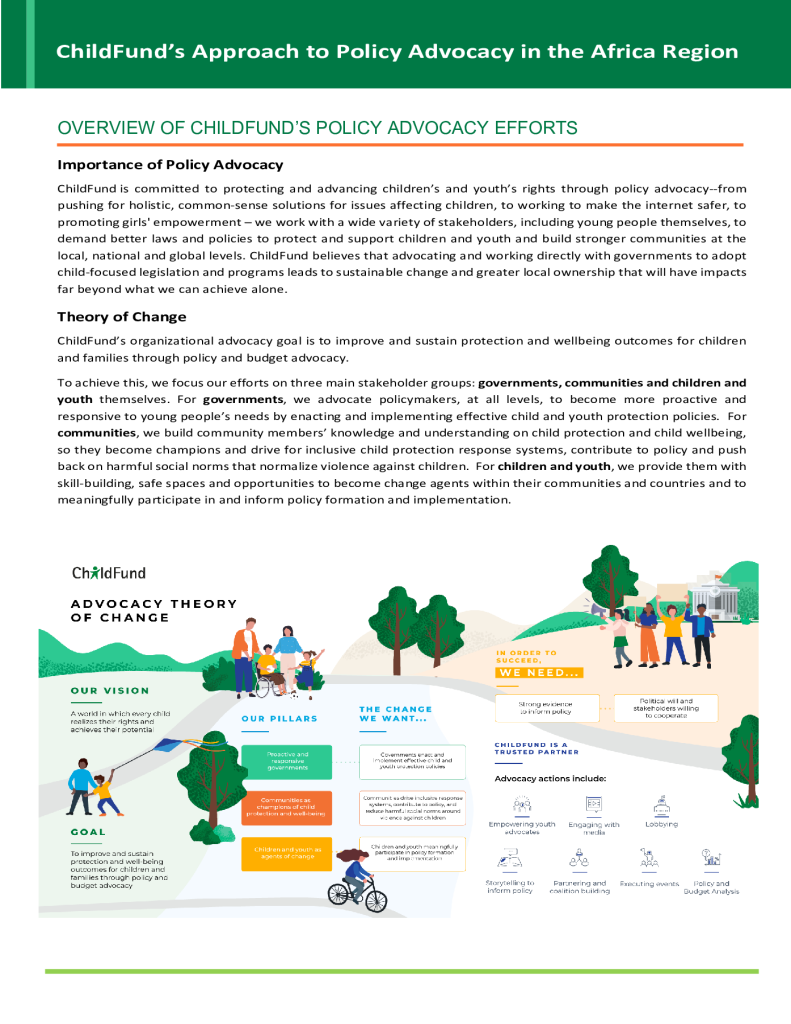
ChildFund is committed to protecting and advancing children’s and youth’s rights through policy advocacy - from pushing for holistic, common-sense solutions for issues affecting children, to working to make the internet safer, to promoting girls' empowerment – we work with a wide variety of stakeholders, including young people themselves, to demand better laws and policies to protect and support children and youth and build stronger communities at the local, national and global levels. ChildFund believes that advocating and working directly with governments to adopt child-focused legislation and programs leads to sustainable change and greater local ownership that will have impacts far beyond what we can achieve alone.

2023

ChildFund’s Education for Protection and Wellbeing (EPW) Model Model targets children ages 6-12, their teachers and their caregivers, over a two-year period in schools. The EPW model places a strong emphasis on improving relationships within and between levels of the ecological model among children, caregivers,and teachers.

This brief reflects input from across ChildFund Alliance members on the climate crisis. Case studies within the brief offer insights into this complex issue, in addition to recommendations for potential development of joint projects among Alliance members and country offices.

2023

This report summarizes findings from the ChildFund Alliance Program Committee’s Climate and Environment Working Group’s online workshop, The Participation of Children and Youth as Transformation Champions: A Youth Practitioner Workshop, held in October 2023. The workshop aimed to shed light on the challenges faced by youth and children in the context of mental health, resource access, capacity building, and policy influencing, within the changing climate landscape.

This Declaration sets out the ambition of the Africa Youth Climate Assembly as a precursor to the inaugural African Union Heads of State and Government Africa Climate Summit (ACS) with the outcomes of the Assembly feeding into the African Heads of State and Government Nairobi Declaration in 2023.

2023

This Policy Brief, prepared by ChidFund, in collaboration with the African Child Policy ForumInternational, is a succinct summary of two extended policy briefs on the scale, drivers and impact of online sexual exploitation and abuse of children and programmatic, policy efforts and gaps, respectively.